
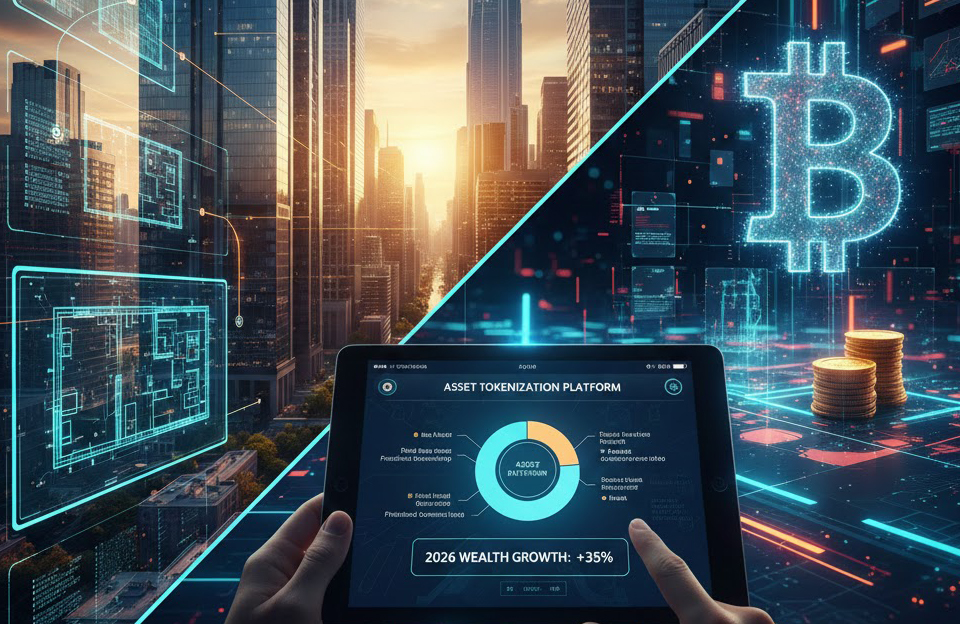
For decades, high-value real estate was a “closed-door” club reserved for institutional investors and the ultra-wealthy. If you wanted a piece of a prime Manhattan office building or a Dubai luxury villa, you needed millions in liquidity.
However, as we move through 2026, the barrier to entry has officially collapsed. Real Estate Asset Tokenization has emerged as the most disruptive force in global finance, turning illiquid brick-and-mortar assets into tradable digital tokens.
What is tokenization of real estate assets?
Fundamentally, tokenization is the process of turning a physical property’s ownership into digital tokens on a blockchain. A fractional portion of the underlying asset is represented by each token.
Think of it as a public company issuing stock, but you own “fractions” of a particular rental property or business complex rather than shares in a corporation. Because of this, investors can begin constructing a portfolio with as little as $100.
The Reasons Behind Foreign Investors’ Attraction to Fractional Ownership
Three significant changes in the global economy are the main causes of the increase in foreign traffic to tokenized platforms, not just hype:
- Instant Liquidity: Selling a home usually takes several months. Tokenized shares can be traded on secondary markets 24/7, much like the best AI tools simplify complex workflows, these platforms automate the legal and transfer process.
- Global Accessibility: A student in Berlin can now own a 0.5% stake in a logistics hub in Texas without worrying about cross-border legalities, thanks to Smart Contracts.
- Transparency & Security: By cutting out the middlemen—bankers, brokers, and hidden administrators—we’ve stripped away the junk fees that usually drain your returns. You keep what you earn.
The New Math: Rental Yields in 2026
- Rent on Autopilot
- The Power of “Fractional” Compounding: In the old days, you couldn’t buy 1/100th of a house with your spare change. Now, you can. Take your monthly dividends and instantly snap up “fractions” of new properties. It’s the easiest way to stack your portfolio and let compounding do the heavy lifting.
This model is significantly more efficient than traditional “Rent-to-Own” schemes, which we previously discussed as an under-the-radar income stream. While rent-to-own requires local management, tokenization is truly “hands-off.”
Risks to Consider in 2026
While the CPC for “Blockchain Real Estate” is at an all-time high due to massive institutional backing, beginners must remain cautious.
- Don’t Skip the Paperwork
- Take Your Tokens “Off-Exchange”
How to Get Your Foot in the Door
Ready to start? Don’t just throw money at the first shiny app you see. Here is how you actually build a portfolio that lasts:
- Vet the Platform First: You want a team with a track record. Stick to the heavy hitters like RealT or Lofty, or the newer leaders that have proven themselves through the start of 2026. If they haven’t been through a few market cycles, be careful.
- Look at the Bricks and Mortar: Remember, you aren’t just buying a digital code; you’re buying a piece of a building. Do your homework. Is the neighborhood improving? Are the tenants actually paying their rent? If the “yield” looks too good to be true, it probably is.
- Spread Your Bets: The biggest mistake you can make is falling in love with one property. Use the tech to your advantage—put a little into a Chicago duplex, some into a London warehouse, and maybe a retail spot in Tokyo. If one local economy hits a rough patch, your other properties will keep the checks coming in.
Conclusion
Tokenized real estate isn’t some “future trend” we’re waiting for—it’s how wealth is being built right now in 2026. We’ve finally cut through the red tape and the gatekeeping of old-school banks. For the first time, you don’t need a million-dollar net worth to own a high-performing portfolio. The barrier to entry is gone; now, it’s just about who has the best strategy.

Leo Sinclair is a financial writer and early adopter of decentralized finance. Specializing in fractional ownership and global income streams, they focus on making complex wealth-building strategies accessible to everyone. Leo Sinclair provides actionable insights for the modern investor looking to diversify in the 2026 market.