
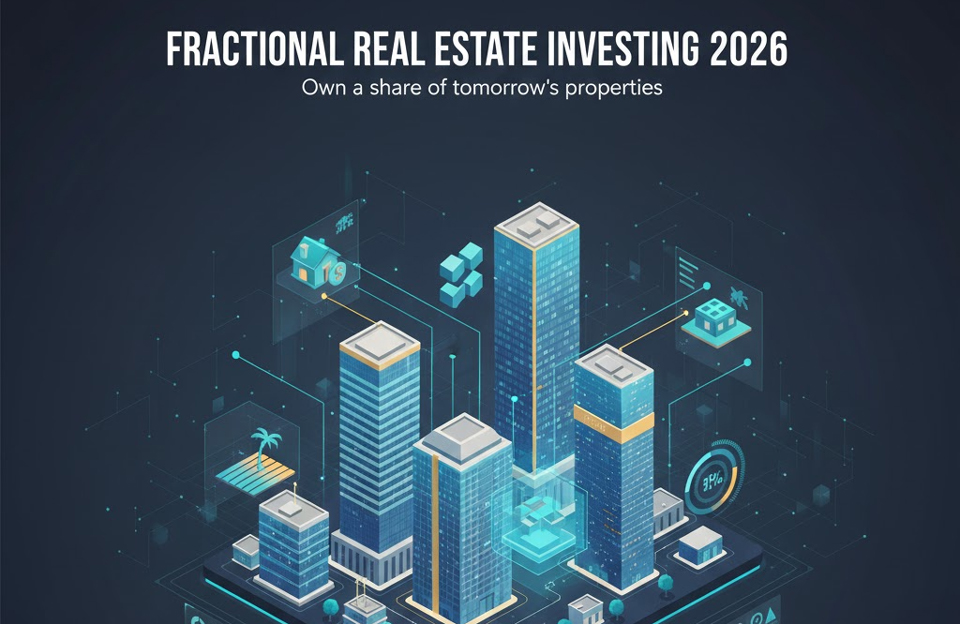
The dream of owning real estate has changed. For decades, the “entry fee” to property investment was a massive down payment, a high credit score, and a 30-year mortgage commitment. But in 2026, technology has democratized the world’s most stable asset class.
Enter Fractional Real Estate Investing. Instead of buying one house for $500,000, you can now buy a “fraction” of 100 different houses for $100 each. You get your share of the monthly rent and your share of the property’s appreciation over time—all without ever having to fix a leaking pipe or deal with a tenant.
How Fractional Investing Works in 2026
The process is powered by Tokenization. A property is purchased by a platform, divided into thousands of digital shares, and offered to investors.
- Passive Income: Rent is distributed automatically to your digital wallet every month.
- Low Entry Barrier: Most platforms in 2026 allow you to start with as little as $100 or even $50.
- Liquidity: Unlike traditional real estate which takes months to sell, fractional shares can often be traded on secondary markets within days.
Top Platforms Disrupting the Market
In 2026, these three platforms are leading the international market:
- Lofty (Global): Uses blockchain to offer daily rent distributions.
- Arrived (US Focus): Backed by big names, focusing on high-growth residential and vacation rentals (Airbnbs).
- EstateGuru (Europe): Specialized in short-term, property-backed loans for developers.
If you are using these apps to manage your portfolio, your digital security is paramount. See our AI-Powered Cybersecurity 2026 guide to keep your investment accounts safe.
Fractional Real Estate vs. REITs: What’s Better?
Many people confuse fractional investing with REITs (Real Estate Investment Trusts).
- REITs: You are buying a stock of a company that owns thousands of buildings. You have no control over which ones.
- Fractional: You choose the specific house. If you think a tech hub is going to boom, you can put your money specifically into houses in that city.
The Digital Nomad’s Investment Strategy
For nomads and remote workers, fractional real estate is the ultimate “borderless” investment.
- No Maintenance: The platform handles the “dirty work” (repairs, taxes, tenants).
- Currency Diversification: Earn rent in USD or Euros while living in lower-cost countries.
Before you start investing, you need to know how much you can actually afford to put away. Use our 50/30/20 Rule Calculator to determine your “Savings” bucket.
Tax Implications for 2026
While fractional investing is easy, the tax side can be complex because you are technically a “property owner.”
Depending on your country of residence, these earnings might be taxed differently. Check our Tax Deductions for Freelancers 2026 to see how to manage your investment income efficiently.
Conclusion: Is 2026 a Safe Bet?
One “hard asset” is real estate. People will always need a place to live, despite the volatility of stocks and cryptocurrencies. Fractional investing is a long-term wealth-building strategy that is now available to everyone; it is not a “get-rich-quick” plan.
If you have $100 sitting idle in your bank account, 2026 is the year to move it into a “fraction” of the real world.

Leo Sinclair is a financial writer and early adopter of decentralized finance. Specializing in fractional ownership and global income streams, they focus on making complex wealth-building strategies accessible to everyone. Leo Sinclair provides actionable insights for the modern investor looking to diversify in the 2026 market.